Planning Your Silver Bull Market Exit Strategy
James Wesley, Rawles
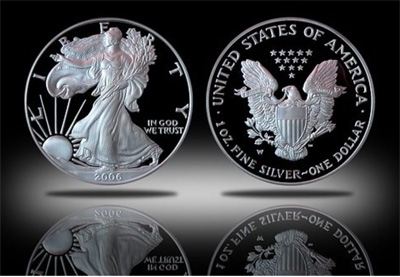 The recent physical silver shortage and the run-up in the spot and futures prices of silver (around $59 USD per Troy ounce the last time that I checked) has prompted me to issue some supplementary advice about how and when to SELL some of your silver. We should all be ready to start slowly SELLING or trading a large part of our silver once the spot price passes $125 per ounce. The recent physical silver shortage and the run-up in the spot and futures prices of silver (around $59 USD per Troy ounce the last time that I checked) has prompted me to issue some supplementary advice about how and when to SELL some of your silver. We should all be ready to start slowly SELLING or trading a large part of our silver once the spot price passes $125 per ounce.
There will almost certainly be a peak and then a crash in silver. I don’t have a crystal ball, but I’ll go out on a limb and predict that the peak could be at just under $200 USD per Troy ounce.
First, for a frame of reference, here is some market history for Au and Ag, courtesy of SilverPrice.org, as I’m writing this on Sunday, December 7th, 2025:
As you can see, silver appears to be in what economists call a Primary Bull Market. Given recent world events and the ongoing inflationary destruction of fiat currencies, this will probably soon develop into a Mania stage. We could even witness a global credit and currency collapse, with an externally-instituted revaluation of silver and gold.
Next, I have a few general reminders:
- Watch the markets closely, worldwide. Presently, Asian buyers are driving the gold and silver markets.
- Watch government regulations and exchange margin requirements closely. If the Comex radically raises their margin requirements, or if they issue a new “downtick-only” rule for buying long contracts, then expect a sharp market correction. (Yes, in a runaway bull market, they could create an inverse of the Rule 201 for bear markets.) But if the exchange issues a “cash settlement only” rule, then expect a sharp rise in the market. (The Comex cannot control the world’s other exchanges.)
- Watch the silver-to-gold price ratio closely. If it rises again to above 75-to-1, then you should trade some of your gold for silver. If the ratio drops below 15-to-1, then you should trade some silver for gold.
- I expect to see silver continue to outperform gold. Look for a silver-to-gold ratio below 50-to-1 within a year.
MAINTAIN YOUR CORE STOCKPILE
Always maintain a small core holding of pre-1965 “junk” 90% silver coins, regardless of the price of silver. This core stockpile is intended for you to pass on to the future generations of your family, and to maintain the ability to barter for necessities. Depending on the composition of your entire investing portfolio, that core might be as much as 10% of your net worth. Since one intent is barter, your core holdings should be “small silver” — one-ounce or smaller coins.
WHEN YOU DO SELL…
- Sell your gold before you sell any silver.
- Sell your numismatic silver before you sell your bullion silver.
- Just as with buying precious metals, it is best to sell locally and quietly — preferably for cash. (With little or no paper trail.)
- Sell in increments of less than $10,000 each, to avoid Cash Transaction Reports (CTRs), by dealers and financial institutions.
- Sell your unserialized large silver (bars, 5-ounce coins, etc.) before you sell your serialized small bars and small silver coins.
- Sell your generic .999 silver rounds and bars (“Trade dollars” and “Christmas bars”) before you sell your U.S. American Eagles.
- Sell your loose green-top U.S. American Eagle tubes before you sell your sealed 500-ounce Monster Boxes. (By the way, congrats to those of you who bought Monster Boxes for around $9,000. They are now priced at $41,500 each. At the top of the spike, they might be selling for $155,000.)
- Quickly put the proceeds of any silver sales into other tangible investments. This could include: Paying off your home mortgage, buying/equipping/stocking a retreat property, investing in high quality firearms (both modern and antique) and barterable black rifles, and common caliber ammunition. Perhaps also consider investing in a Swiss watch, a classic car, or a classic 4WD pickup truck. Do notleave your silver profits in Dollars, or they will probably be burned up by inflation.
SOME SELLING MILEPOSTS
If you were wise, you probably got into silver using Dollar cost averaging. You should exit, in much the same way.
Do not expect silver to go up, indefinitely. Almost every major spike in a commodity market is followed by a crash. This is exactly what happened in 1980, when there was the last big silver price spike. (If you are not familiar with this event, then do a web search on the phrase: “Hunt Brothers Silver Crash”.) Learn from history.
You should slowly unwind your investment position in silver, as it rises. Don’t be a pig. There is a wise old saying on Wall Street:
“Bulls make money, and bears make money, but pigs get slaughtered.”
Your mileage may vary, but assuming that you bought most or all of your silver at below $30 per Troy ounce, here are some suggested “ballpark” market milestones for silver:
- Spot silver passes $60 per ounce: Sell 5% of your silver holdings.
- Spot silver passes $70 per ounce: Sell 5% of your silver holdings.
- Spot silver passes $85 per ounce: Sell 5% of your silver holdings.
- Spot silver passes $90 per ounce: Sell 5% of your silver holdings.
- Spot silver passes $100 per ounce: Sell 10% of your silver holdings.
- Spot silver passes $140 per ounce: Sell 10% of your silver holdings.
- Spot silver passes $160 per ounce: Sell 10% of your silver holdings.
- Spot silver passes $180 per ounce: Sell 10% of your silver holdings.
- Spot silver passes $195 per ounce: Sell 10% of your silver holdings.
Take note that those sales would total 70% of your current silver holdings. Also note that you will break even on all of your initial purchase cost when silver gets above about $90 per ounce.
You should consider the remaining 30% your core “do not touch” holdings.
Lastly, I must urge my readers to please be dispassionate about all of your investment decisions. Emotional investors often make costly mistakes. – JWR
 I’m a survivalist author and lecturer. I’m the founder and senior editor of SurvivalBlog.com. I’m a former U.S. Army intelligence officer, and now work as a full-time blogger and freelance writer. This blog reflects my interests. I’ve been an enthusiastic survivalist since my teenage years. I grew up in the Bomb Shelter era, and that mind set just never wore off. I’m a survivalist author and lecturer. I’m the founder and senior editor of SurvivalBlog.com. I’m a former U.S. Army intelligence officer, and now work as a full-time blogger and freelance writer. This blog reflects my interests. I’ve been an enthusiastic survivalist since my teenage years. I grew up in the Bomb Shelter era, and that mind set just never wore off.
I have authored several best selling nonfiction and fiction survivalists books. My expertise is primarily in retreat security, food storage, firearms, communications, first aid, and off-grid power systems. I have a B.A. degree in Journalism from San Jose State University with minor degrees in Military Science, History, and Military History. I served as a U.S. Army Intelligence Corps officer and held a Top Secret security clearance with SCI access. I attended the Army NBC defense officer’s course, as well as Northern Warfare School at Fort Greeley, Alaska. Before resigning my commission as a Captain, I worked numerous live intelligence gathering and analysis missions overseas at the tactical and strategic levels.
SurvivalBlog has more than 320,000 unique visitors per week, and it is considered the Internet’s premier source of information on family preparedness and survival topics.
I am of primarily English ancestry, a Christian, and hold to Reformed doctrine. I am saved by God’s Grace and Christ’s blood, and not ashamed to say so!
My view of history is of the geographical determinist school. My view of economics is of the Austrian school. Politically, I am a conservative/Constitutionalist libertarian. These outlooks have shaped my views on preparedness.
My initial civilian career was as a journalist and technical writer. During that time I wrote a full-length survivalist novel, titled “Patriots: Surviving the Coming Collapse.” I later authored several sequels to that novel, one of which reached #3 on the New York Times bestsellers list. I also wrote the very popular non-fiction book “How to Survive the End of the World as We Know It: Tactics, Techniques, and Technologies for Uncertain Times”. I eventually wrote four sequels in the “Patriots” series, and three other nonfiction books.
I started using the Internet in the late 1980s, before most Americans had even heard of it. I began posting about survival topics to Usenet newsgroups (such as misc.investing, rec.guns, and alt.survivalism) in the early 1990s.
In 1987, I married The Memsahib. She passed away in 2009 and is greatly missed. Through God’s tremendous providence, I remarried in 2010, to “Avalanche Lily”.
We homeschooled our children. We live at the Rawles Ranch “Somewhere in The American Redoubt.” Our family enjoys hiking, rockhounding, hunting, kayaking, and target shooting.
As part of our charitable works, we support Baan Shufan, an ophanage in northern Thailand. We also send “care packages” to troops deployed overseas through Any Soldier, and we support Compassion International. I highly recommend all of these charities.
I was on the staff of Defense Electronics magazine for four years. I researched, wrote, and edited more than 60 feature-length technical magazine articles on a wide range of high technology subjects including component technologies, computer hardware and software, foreign military organizations and equipment, high technology terrorism, aircraft, air defense, missile guidance, digital flight controls, intelligence gathering and analysis, antisubmarine warfare, satellites, and communications equipment. I concurrently held the position of Managing Editor of The International Countermeasures Handbook and The Command, Control, Communications, and Intelligence (C3I) Handbook. I’ve also written for Defense Computing magazine. I’ve also worked for several high technology companies.
I was commissioned as an Army Intelligence Officer–35A(5M)–in 1984. I specialized in signals intelligence and electronic warfare. Other than my Officer’s Basic Course at Fort Huachuca and a couple of stints of temporary active duty (TDY), I spent my commissioned time as a reserve officer, with the 519th ASACompany. (It was later re-designated Co. D of the 373rd CEWI Battalion.) My duty positions included: Operations platoon leader, Electronic Warfare Officer, Intelligence Analyst, NBC Officer, Supply/Service Platoon Leader, and the umpteen other additional duties that the Army loves to heap upon company-grade officers. I also served as a Special Security Officer (SSO). It was my privilege to work “live” Guardrail signals intelligence gathering and analysis missions in West Germany.
I resigned my commission when Bill Clinton was first sworn into office as President. I resigned because I didn’t want to serve under him as Commander in Chief. At the time I was a Captain, and my six-year obligation to the Army had already lapsed.
survivalblog.com
|